

Artist statement
“Colour Process was made in 1984, more than forty years ago. These ancient pixels show up on the screen to remind us that the reality of the rainbow (itself an illusion), can be represented by another form of coloured lights.”
— Patrick Hughes
A rainbow enters the machine
In 1984, Patrick Hughes made a print of a quiet room. A window, a desk, a home computer. Through the window comes a rainbow, painted in clean bands of colour, and it does not stop at the glass. It arcs across the room and pours straight into the screen.
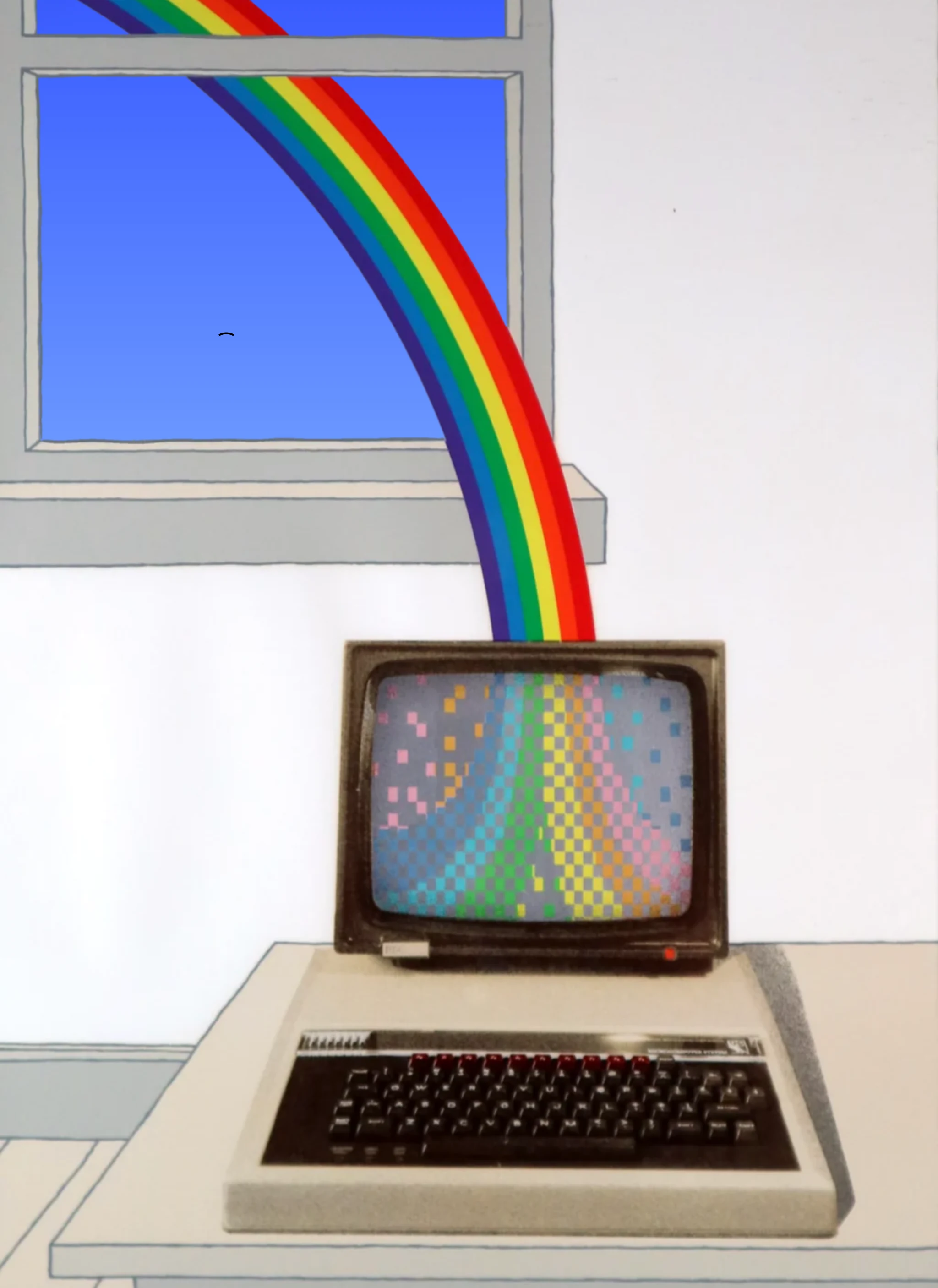
What comes out the other side is no longer a rainbow, exactly. It is a field of chunky, checkered pixels: the computer’s best attempt to rebuild the light it has swallowed, using the only materials it has, red, green and blue.
The joke is a serious one. A rainbow is already an illusion, sunlight split by drops of water into colours that exist only in the eye of the person looking. The screen performs the same trick by other means. Both are coloured light pretending to be something solid. Hughes, who has spent a career making paradoxes you can see, put the two side by side and let them argue.
From print to program
The print captured a single moment: one rainbow, one screen, one afternoon. Colour Process brings the machine back to life.
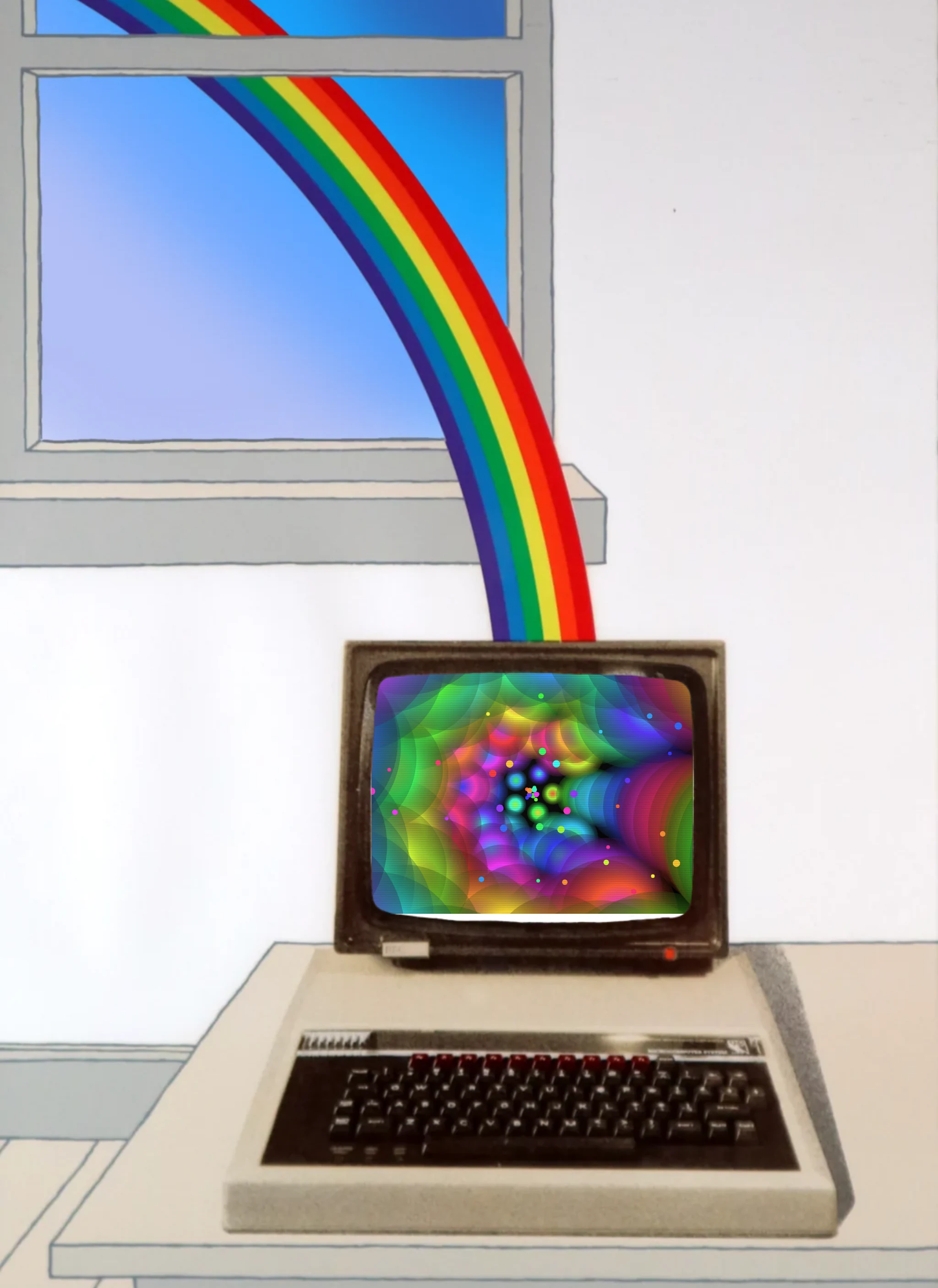
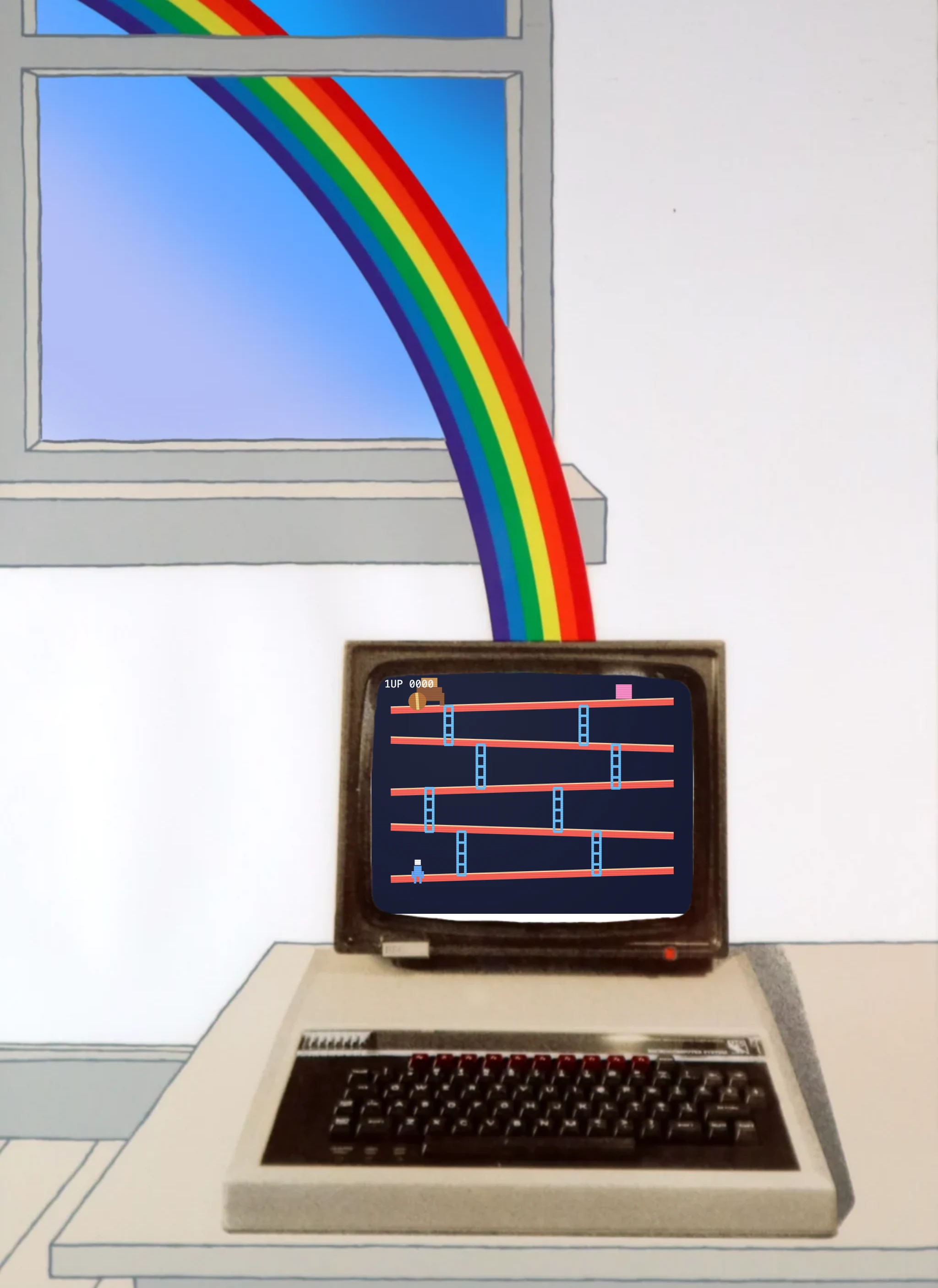
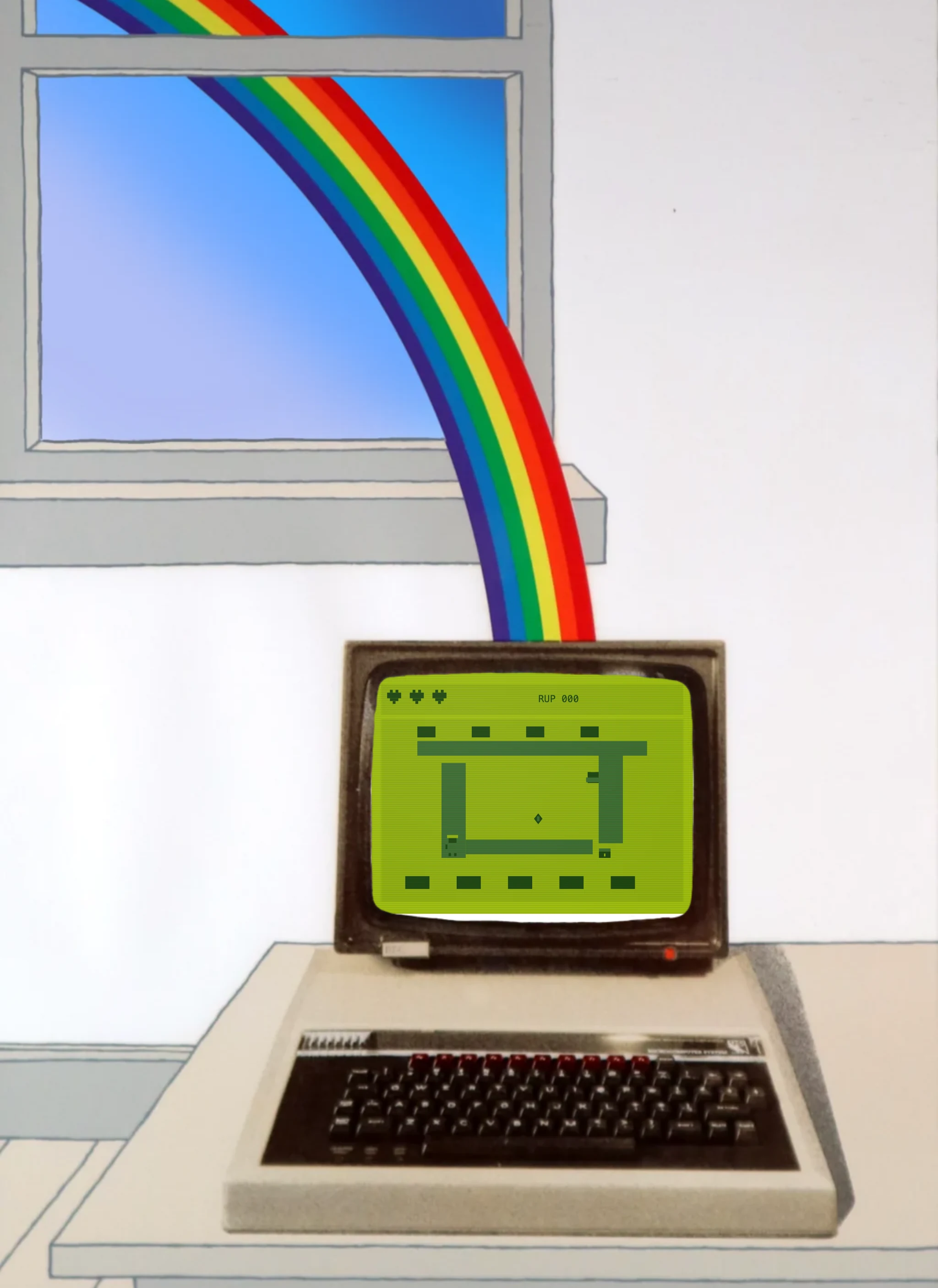
Each of the 100 works is generated by an algorithm, drawing from a vast array of colours and speeds. Outside the window, the world keeps changing. Grey autumn light gives way to bright blue skies, starry nights, moonlight and fireworks. On the screen, the rainbow is processed again and again, sometimes rendered faithfully in its original checkered pixels, sometimes transformed into kaleidoscopic swirls, strobes, or something closer to an early video game.
The constraints of 1984 are not softened or upgraded. The blocky pixels and limited palettes are the point: the fingerprints of an artist working at the very beginning of computer art, now given the motion and variation that the print could only imply.
Inside the system
Every work is built from a set of decisions: what lies outside the window, what appears on the screen, how it is drawn and whether it moves. The generator combines 16 motifs, 10 palettes, 9 effects and 6 settings, layering up to 13 canvases with a colour depth that ranges from 2 to 40.
Outside the window, a quarter of the collection opens onto cosmic skies. Night, dawn and storm scenes are rarer, and only three works are caught at golden hour. Inside the room, 78 works are animated and 22 hold still, and the system draws in two techniques: 78 in Canvas 2D, 22 in CSS. Most works are detailed, but three are intricate, the most complex images the system produces.
Rarest features
- The interactive work: just one piece in the collection responds to the viewer. The other 99 are ambient.
- One-of-one motifs: Bubbles, Cosmos, Fireworks, Hearts and Ocean each appear only once.
- One-of-one palettes: Gold, Teal and Violet each colour a single work.
- One-of-one effects: Mystery and Seasonal each appear once.
- Golden hour and intricate: three works each.
About the artist
Patrick Hughes (b. 1939) is a British artist based in London, best known for inventing reverspective: three-dimensional paintings that appear to move as the viewer walks past them. Across six decades his work has returned again and again to paradox, illusion and the gap between what we see and what is really there. The rainbow has been one of his recurring subjects since the 1960s, a thing everyone can see and no one can touch.
A master of analogue illusion, Hughes has always made images that only complete themselves in the eye of the viewer. Colour Process shows him, in 1984, already looking at the computer screen as the newest kind of illusion. Its return as a generative collection closes the loop.
The auction
Colour Process will be sold as a ranked auction of 100 works on FungibullX.
- Edition: 100 unique variations
100 variations by Patrick Hughes, each algorithmically generated from a vast array of colours and speeds to create a unique digital experience from the master of analogue. Based on his original 1984 print Colour Process.